



How Bolt outperforms AMM routing across size, assets, and market conditions
Key Takeaways
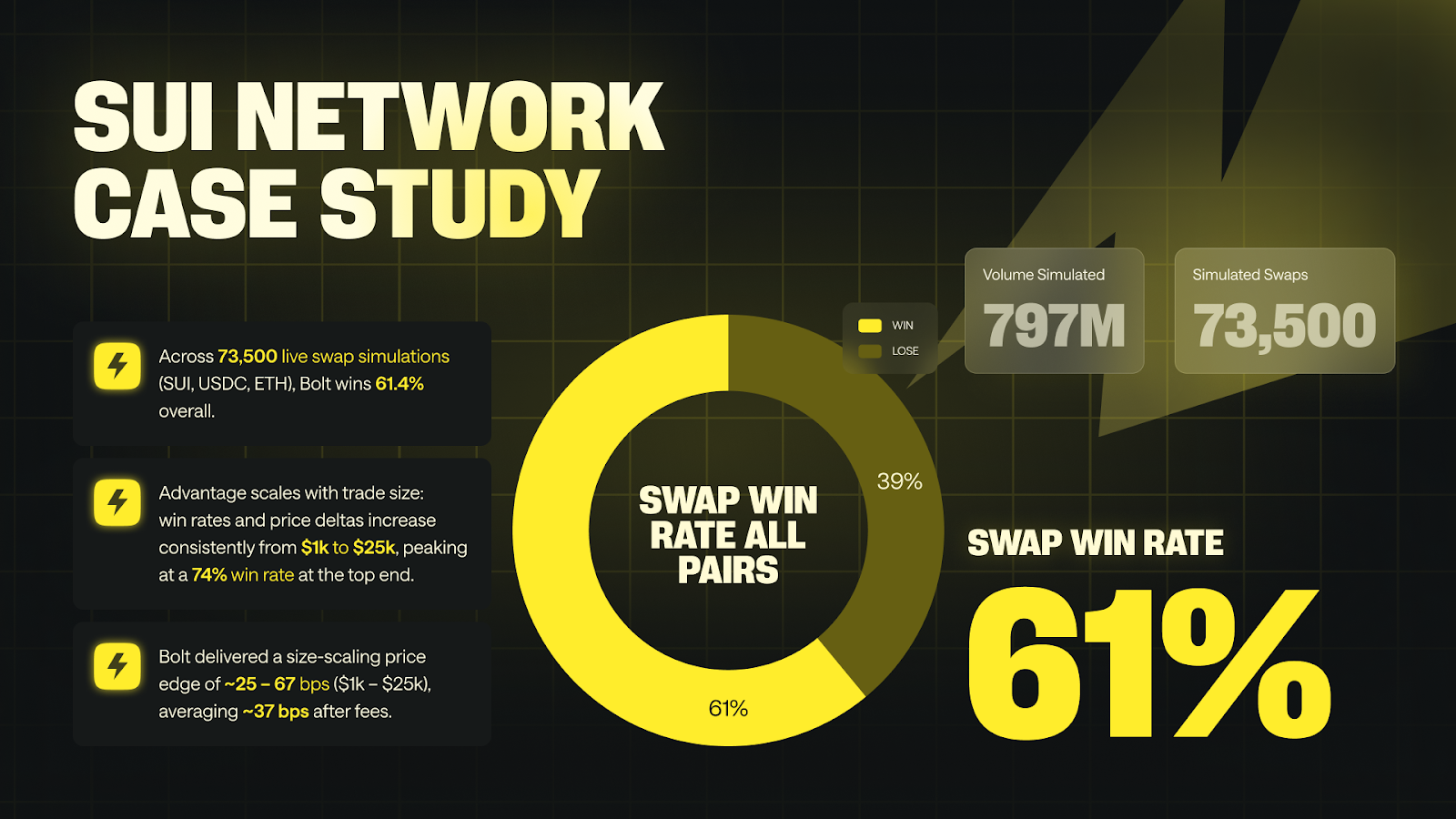
- Across 73,500+ simulated swaps and $797M in modeled volume, Bolt consistently delivered superior execution on Sui.
- Bolt achieved a 61.4% win rate across all tested pairs, with win rates increasing materially as trade size grows.
- For swaps above $25,000, Bolt wins up to 85% of the time, validating its zero-slippage model at institutional size.
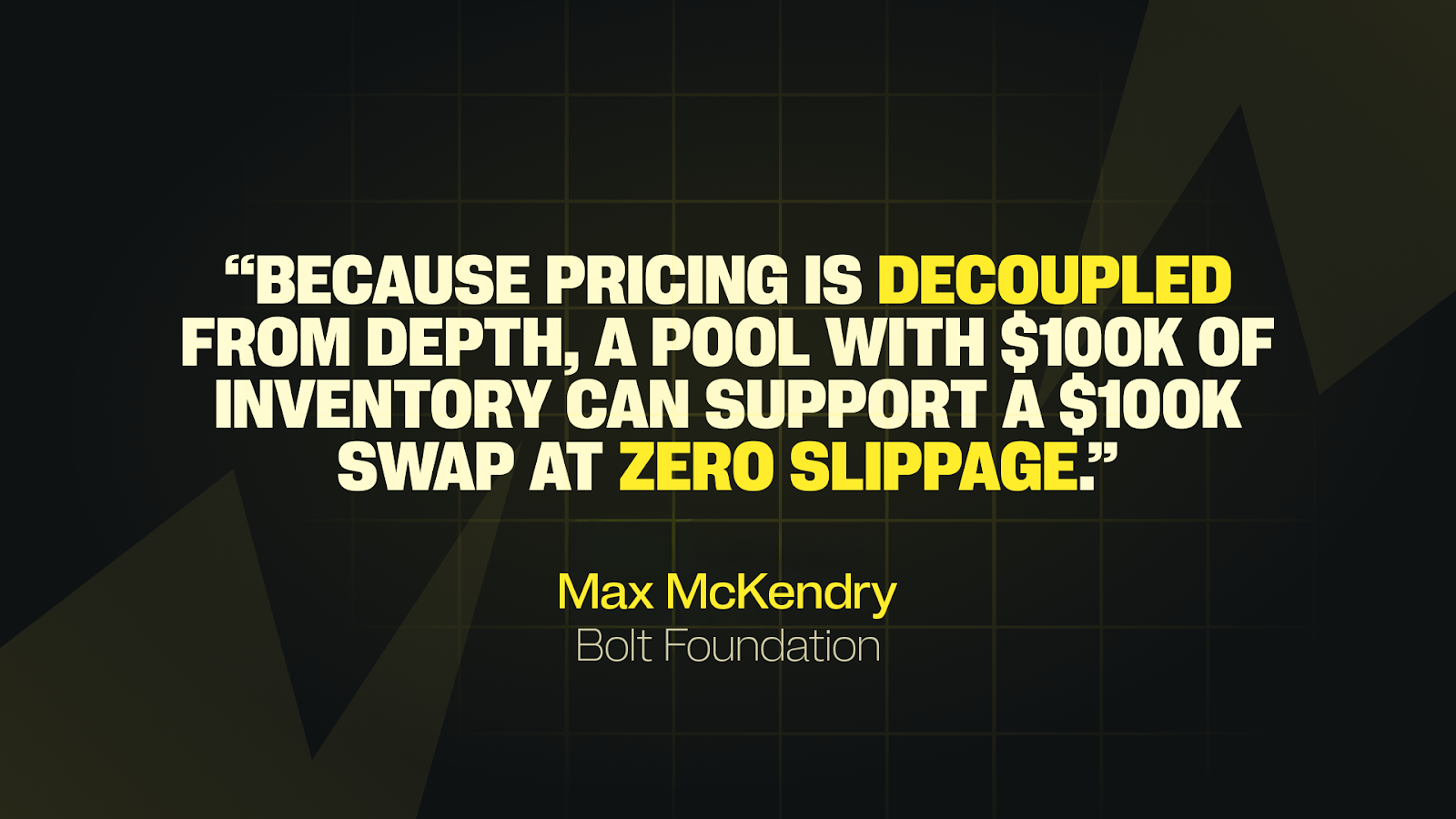
- A $100,000 Bolt pool can service a $100,000 swap with zero slippage, something depth-based models cannot guarantee.
- At launch, Bolt will support SUI/USDC, with additional pairs and deeper liquidity coming quickly.
Overview
Sui has emerged as one of the most performant L1s in production today. Its parallel execution model, low latency, and developer-first design have unlocked a new generation of on-chain applications.
But while execution speed has improved, trade execution quality across DeFi remains constrained by a familiar bottleneck: liquidity depth.
Bolt addresses this constraint directly.
Instead of relying on curve-based pricing and fragmented liquidity pools, Bolt provides zero-slippage execution using an oracle pricing model that scales independently of pool depth. To evaluate how this model performs on Sui, Bolt conducted a comprehensive execution study across tens of thousands of simulated swaps during the platform’s beta phase, with the goal of validating performance while continuing to refine execution parameters.
This article highlights the most important results.
The full dataset is available at the end.
The Dataset
The analysis covers:
- $797M in simulated swap volume
- 73.5K simulated swaps
- $10.8K average trade size
Simulations were designed to reflect real user behavior across a wide range of trade sizes, from retail to institutional, using production-grade routing assumptions.
Win Rates: Bolt Delivers Better Execution More Often
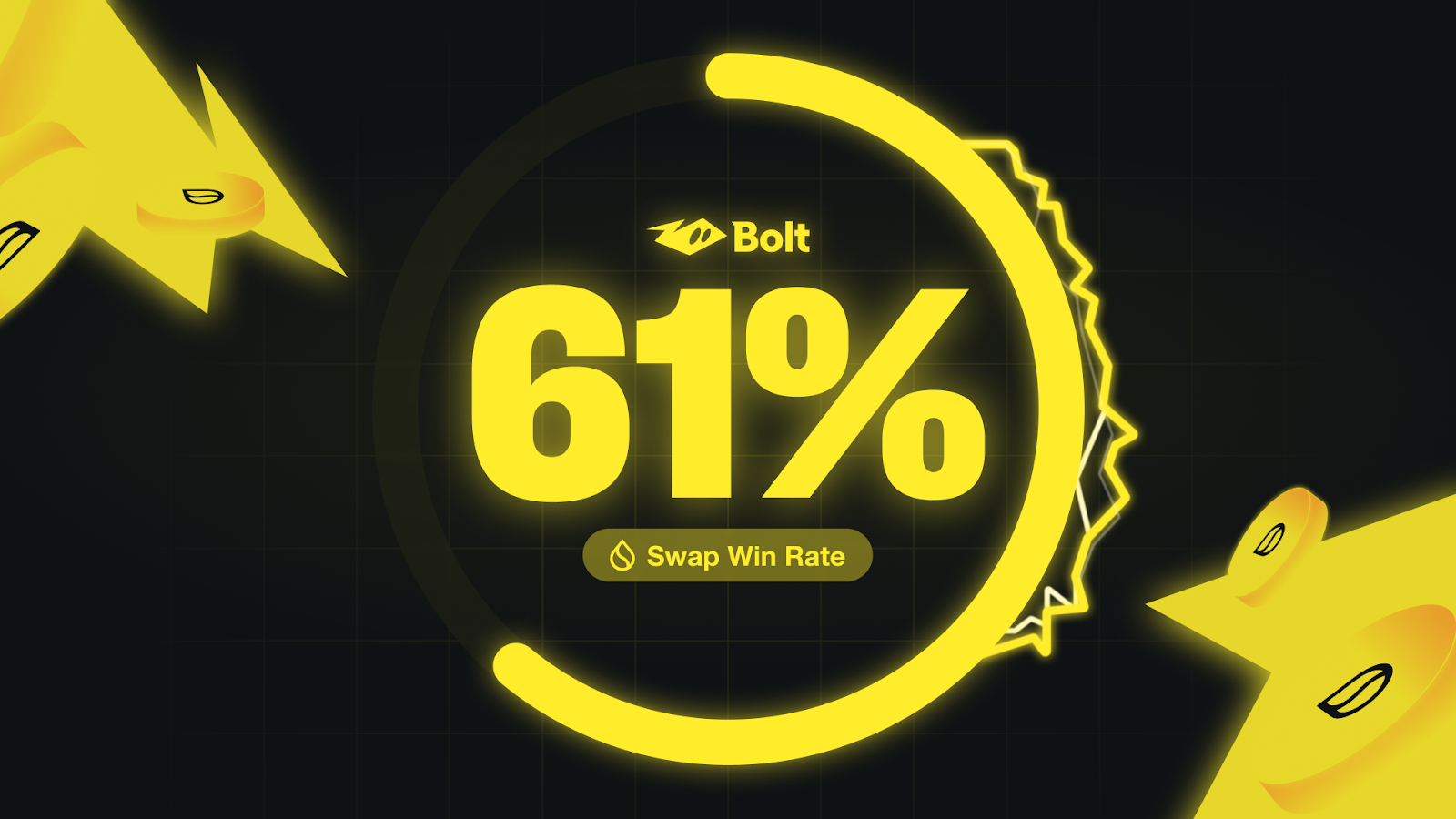
Across all assets and sizes, Bolt delivered better execution in 61.4% of swaps.
While this alone is meaningful, the distribution becomes more compelling as size increases.
Execution Improves as Trades Get Larger
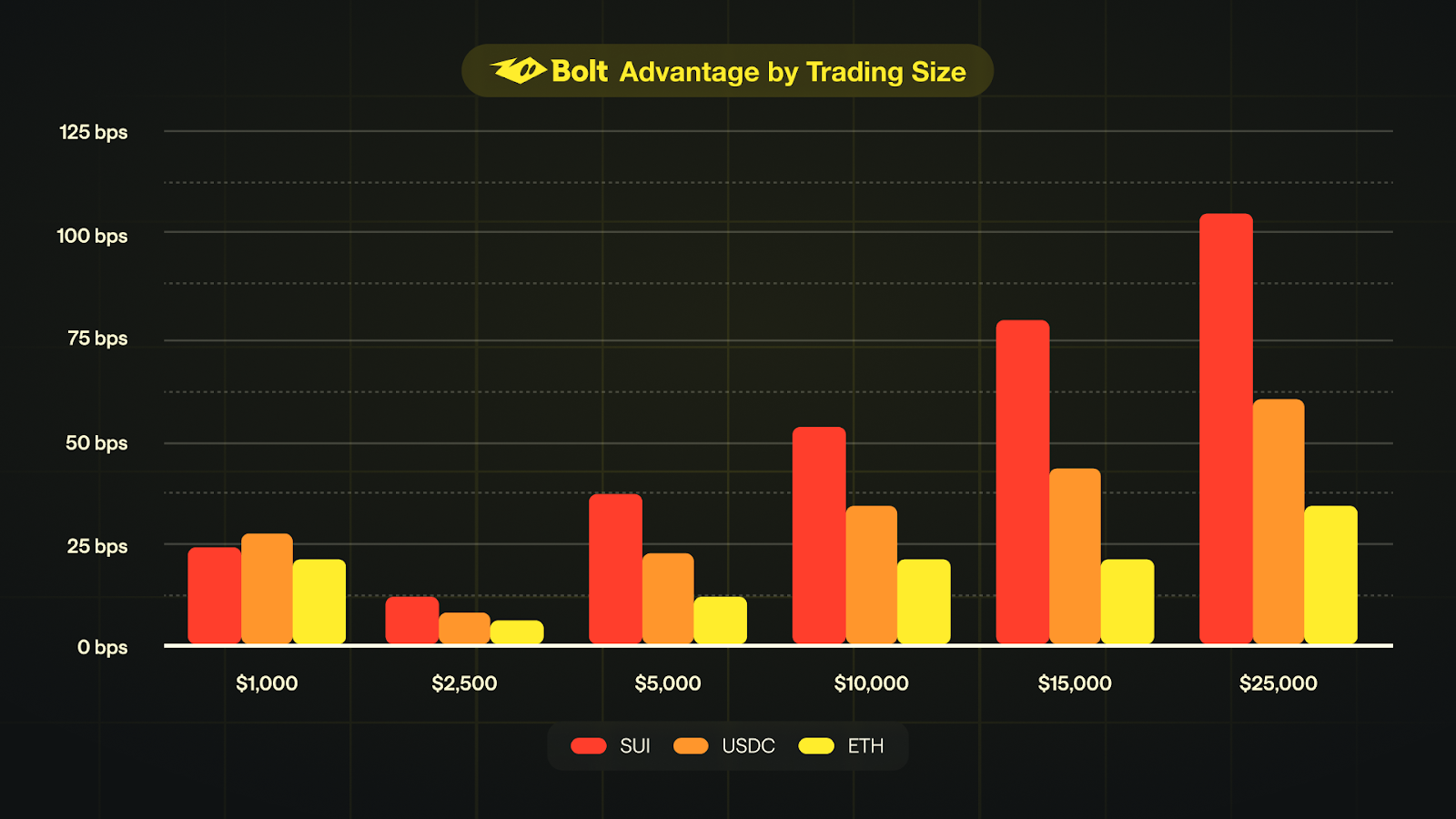
Key takeaway: As trade size increases, Bolt’s execution advantage becomes more pronounced. Larger trades consistently favor Bolt, indicating that performance does not degrade as volume scales.
The difference: AMMs price trades along liquidity curves, so execution quality worsens as swaps consume more depth and optimal routes saturate.
Bolt does not rely on curve-based pricing. Its execution model remains stable regardless of trade size, allowing performance to improve relative to AMMs as trade sizes grow.
Asset-Level Performance
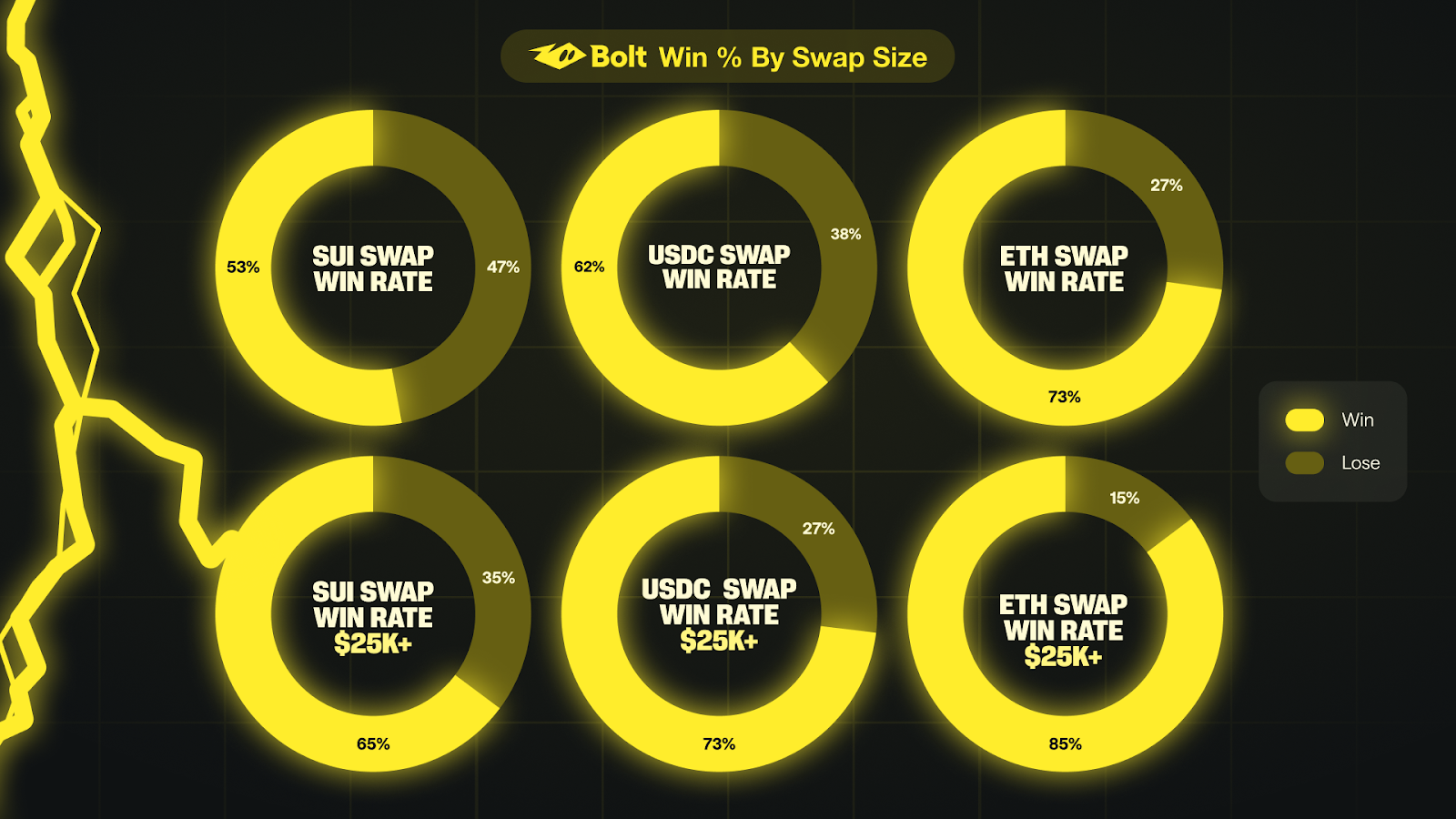
Key takeaway: Across assets, Bolt maintains strong and consistent performance, with its advantage becoming sharper at larger trade sizes rather than collapsing into asset-specific edge cases.
The difference: AMM execution varies by asset because it depends on local pool depth, fragmentation, and market activity. Bolt abstracts away these differences by sourcing execution independently of individual pools.
As a result, execution quality is governed by the same mechanism across assets, producing consistent outcomes regardless of liquidity distribution.
Price Advantage Scales With Size
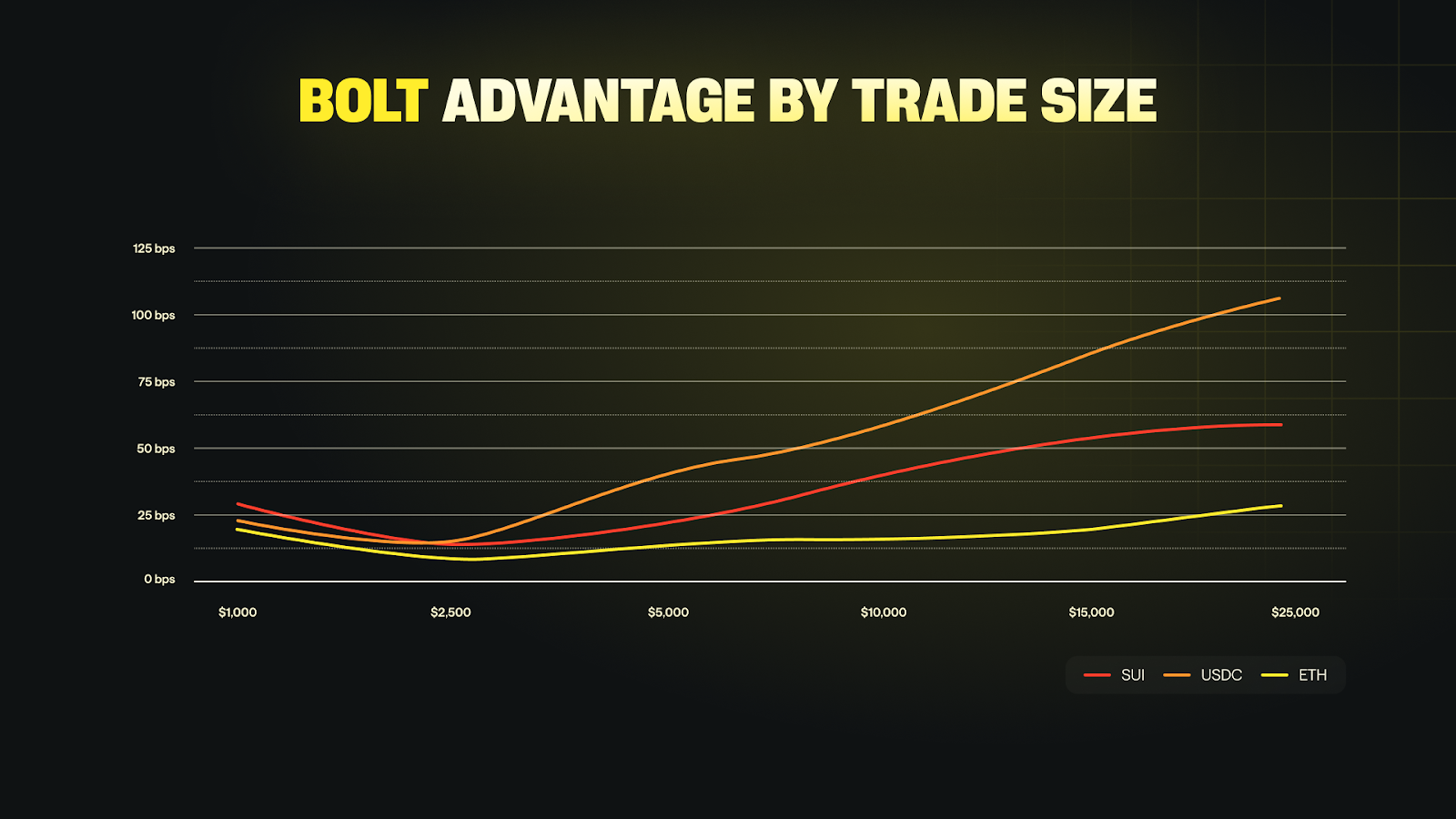
Key takeaway: Bolt doesn’t just win more often at larger sizes. It delivers a larger pricing advantage, reaching materially greater improvements on the biggest trades.
The difference: AMMs embed nonlinear price impact into every trade, causing execution costs to accelerate as size increases. Bolt removes this mechanism entirely. As trades grow, AMM pricing steepens while Bolt remains flat, creating an expanding price advantage driven by architecture rather than incremental optimization.
Why Bolt Wins on Sui
This case study isn’t about tuning parameters or optimizing routes. It’s about architecture.
1. Zero-Slippage Execution
Bolt does not price trades on AMM curves.
Execution is not constrained by pool depth or liquidity fragmentation.
A $100,000 Bolt pool can service a $100,000 swap with zero slippage—by design.
2. Unified Liquidity
Liquidity is not split across fee tiers or venues.
Execution quality doesn’t decay as markets move or volume concentrates.
3. Deterministic, Onchain Execution
Bolt preserves:
⚡️ atomic execution
⚡️ composability
⚡️ predictable settlement
There are no off-chain RFQs, no whitelists, and no broken execution guarantees.
What This Means for Sui Builders
For Sui dApps evaluating execution layers, the implications are straightforward:
⚡️ Better prices for users
⚡️ Stronger execution at scale
⚡️ No trade-off between UX and performance
⚡️ A competitive edge for professional and institutional flows
Bolt integrates as an execution layer, not a frontend, meaning existing UX and routing logic remain intact while execution quality improves.

Conclusion
This case study shows that Bolt’s zero-slippage model isn’t theoretical; it works in practice, at scale, under real trading conditions.
Across $797M in modeled volume, Bolt consistently delivered:
- higher win rates
- increasing advantage with size
- execution stability where AMMs degrade
As Bolt continues through its beta phase, the team will further fine-tune execution parameters, expand liquidity, and support additional trading pairs to improve efficiency and performance.
For Sui, this represents a new execution primitive, one that complements the network’s performance strengths with execution quality to match.
Next Steps
- Review Bolt documentation to unlock zero-slippage execution → Bolt Documentation
- Explore the full case study metrics → Sui Case Study
- Schedule a call with our team to walk through integration → Bolt Intro Call
If you’re building on Sui and care about execution quality at scale, Bolt is ready to ship.

Join the Movement
Bolt is more than a protocol launch — it’s a rallying cry for builders, LPs, traders, and believers to unite around a stronger DeFi ecosystem. The multichain era demands a truly efficient liquidity layer, and Bolt is here to deliver.